Sometimes I clip things I see on the internet that allegedly include advice quoted from famous authors. Some of it sounds like great advice, others not so much.
All writers/authors–old or young, uneducated or fully educated and knowledgeable in the craft, unknown or famous, now dead or still alive–have their own special way of accomplishing what they do. I try out some techniques they’ve advised just to see if it can improve my process by utilizing a new one. Here are a few I’ve grabbed…
The first one is my favorite and for my husband, who I’m sure could build and provide this for me on some property we own out in the country.
George Bernard Shaw

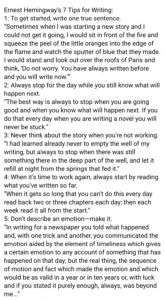
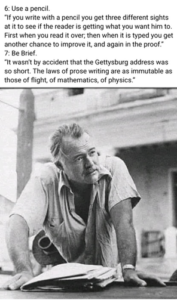
Hemingway (it has a picture of him, so he said all this, right?). I only use one piece of the advice listed here and especially ignore #3…some of my best ideas come when I’m not actually sitting down to write. But I do use #4. Re-reading (all or just my previous chapter or two) each time I start writing works well for me and saves me from some future editing needs. In my case, that’s very helpful.
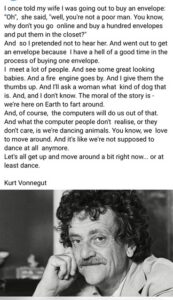
Kurt Vonnegut (again, just add a picture and it verifies everything, right?). This one is good for me because I’m an ambivert. Ambivert is a new word I’ve learned that means I live somewhere solidly between total hermit and social butterfly. But my social batteries are a couple of old double-A’s that have been sitting in the junk drawer too long, so they run out quickly, however; being social is an important part of enjoying life and finding new ideas.
There are other more current authors I admire, such as Fredrick Backman and Frieda McFadden (not her real name, as we all now know), who both seem to enjoy the act of writing while still staying true to themselves. But my heart always breaks to think about Sylvia Plath, who was a writer in a time when it was still commonly frowned on to be a woman and do anything outside of homemaking and child-rearing.
But the best advice came from a random person in an author/writing group that suggested reading your work out loud, and I’ll gladly pass it on:
Do an edit (or edits) where you read your work out loud. When you read silently, your mind can do that nifty trick where it fixes things as you go but it doesn’t tell you it did that. Have you seen those memes that have words written wrong in the first sentence, then the second sentence says that you read that wrong and the third sentence says you read that one wrong, too, and, sure enough, you look at it again and find the mistakes. When you read out loud, your mouth is more likely to trip over those mistakes or badly formed sentences and you can find them.